this is part 1 of a series i am developing: “the psychology of becoming a border”
- part 2: gazing like a border
Reflecting on very different events in my life got me thinking about something unexpected but important: the difference between becoming a border and becoming a table.
These are just early thoughts, but comparing borders to tables has turned out to be a useful metaphor for thinking about how I want to live. Maybe it’ll be useful to you too.
becoming a border
The Mexico-U.S. border was always a looming figure in my life as an illegalized immigrant in Houston, Texas. The closeness and danger of the border would ebb and flow. As a child, it felt like a distant storm, easy to ignore as background, though I could still sense its dangerous presence. When I got older, my friends would visit South Padre Island for the summer, and I knew I couldn’t join because of the documentation check points on the highways near the border. The same way we would have to navigate carefully around Houston to not have run ins with the cops. In these moments, the border would transform from a faraway background presence into pervasive tentacular obstacles. What always remained consistent for me was the image of “the border” as a specific material/geographic region that I crossed at some point. That was until I recently read this article: “No Citizens: Abolishing Borders Beyond the Nation-State“.
It introduced me to a specific phrase that sparked a new thought for me: “All Cops Are Borders“. There is an obvious way in which this can be understood: cops are mobilized to enforce the illegalization/capture/expulsion of immigrants, a violence that reflects this nation’s racist political history and future. But it also opened up another idea: that individual people—or entire groups—can become borders themselves. They become bodily extensions of the material border, its arms, its checkpoints, unmoored from a specific geography. The border now exists everywhere and anywhere people function & act like borders.
Around the same time, I was reading Sara Ahmed’s writing on complaints, where she exposes a common institutional and group dynamic that I was also experiencing: pointing out a problem can turn YOU into the problem. People within an institution (or social group) redirect their energy not toward addressing the problem, but toward managing you—silencing, suppressing, punishing, or exiling the person who spoke up. In doing so, they act like borders. Not necessarily cops, but definitely obstacles.
So whether an individual is marshaling the institutional power of a nation, an organization, or social/political hierarchies within a group, they carry the institution with them and can become a border, where they function as (immediate and/or distant) obstacles to others’ paths or movement in this world.
becoming a table
This next part is embarrassing, but I came across one of those GPT prompts that is meant to help you reflect on your life and give you advice. At first, it produced sugarcoated words that simply echoed my own reflections back at me. But then I asked it to be honest and not spare my feelings. This was its final message:
“Final Message You Need to Read Right Now (Blunt Wisdom):
Stop pretending you’re still fighting the same war. You’re not undocumented anymore. You’re not living in a trailer park. You’re not a child trying to earn the right to exist. You’re here. You made it. Now act like it.
No one’s coming to take it all away. The threats were real once—but now, the biggest threat is your refusal to release the survival patterns that once saved you but are now quietly suffocating you.
You don’t need to fight for a seat anymore. You are the table. But if you keep waiting for the world to validate your peace, you’ll never truly sit down.
Start living like you’ve already won. Because you have.”
Ok, damn bitch! But also, slay.
A friend I really admire pointed out one phrase in particular: “you are the table“. In that message, to be at the table (or even be the table) is to have “achieved“ recognition or legitimacy in society as a person, as an equal, or as a success story. But I also know that this kind of table works like a border: one that excludes and divides people through performances of deservingness, upheld by the myth of meritocracy.
What came to my mind instead was the relational functions of an everyday table: a place where people congregate, share meals and conversations, strategize, play, connect. As Sara Ahmed identified: a table can inherit histories, gather things that make a place feel like home, support a wide range of actions, and (re)orient people, shaping how they move through the world. To be or become a table is to produce the opposite outcomes of a border: enable connection, enable movement, bring people together. Therefore,
every day, in every interaction, you have a choice:
will you become a border,
or will you become a table?
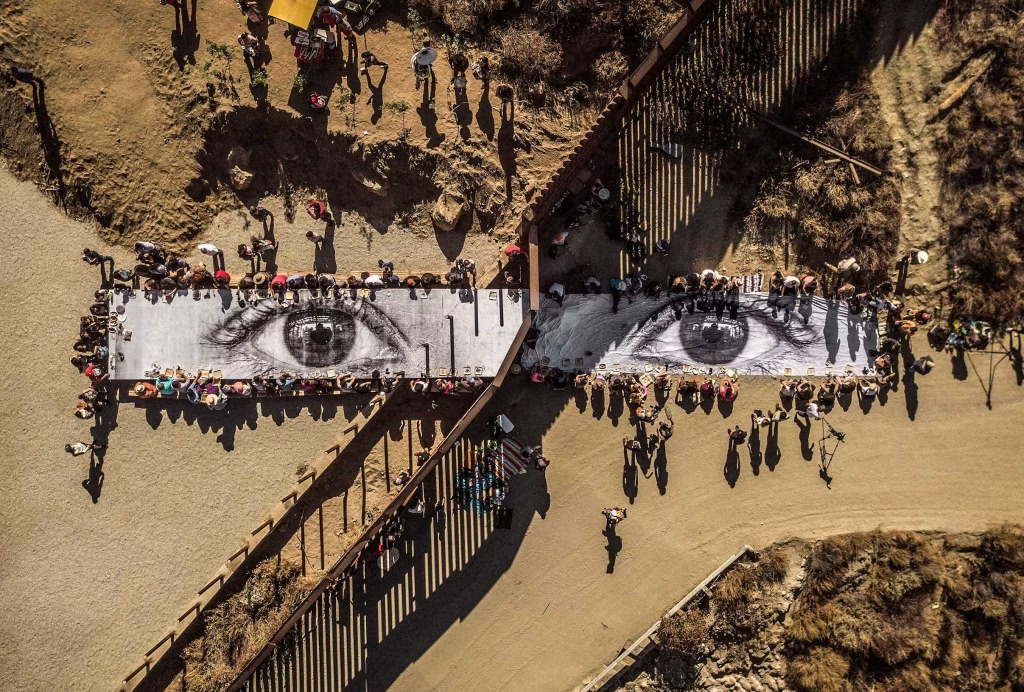
That same friend also shared an art installation with me that captured this opposition between borders and tables so perfectly:
“In 2017, JR created a gigantic installation of a toddler named Kikito peeking over the border fence that separates the United States and Mexico. On the final day of the installation, JR organized a picnic that took place across both sides of the fence. Kikito, his family, and hundreds of guests from both the United States and Mexico came together to share a meal. Everyone gathered around a long table that stretched across both sides of the fence. The table showed the eyes of a Dreamer – a term that describes undocumented immigrants who arrived in the United States as children. It was a joyous occasion as people passed food and tea back and forth and enjoyed the music of a mariachi band––half the ensemble played on each side of the fence. For a few hours, the division disappeared.”